NAIROBI 2029 – A World Championships Comes to Africa, at Last
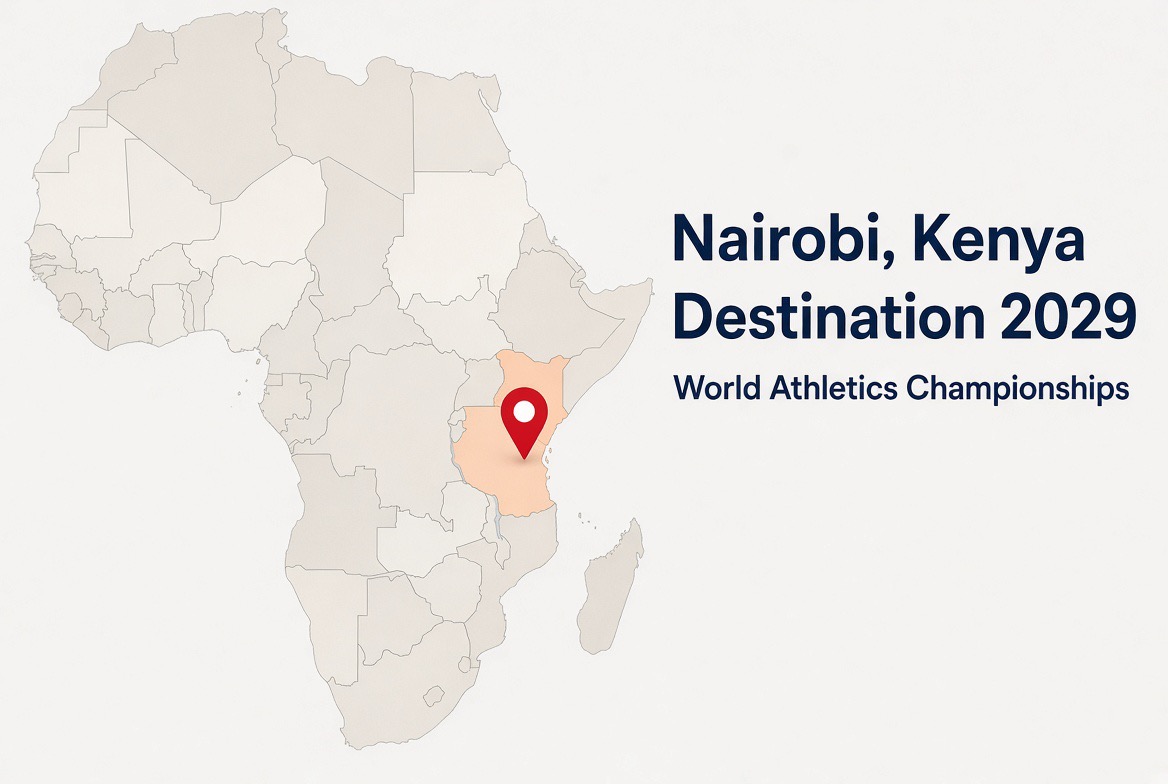 World Athletics has announced that Nairobi, Kenya, will host the 2029 World Athletics Championships — the first time in the sport’s history that its flagship outdoor event will be held on African soil. The decision came from the World Athletics Council, which also awarded the 2031 championships to Munich, setting a rotation that carries the sport’s biggest meet through Asia, Africa, and Europe over three consecutive editions.
It is hard to overstate what this corrects. Since the championships began in Helsinki in 1983, the event has traveled through Europe, Asia, and North America without once setting foot on the continent that has done more than any other to define distance and middle-distance running. Nairobi’s win closes that gap, and it does so at Kasarani — a stadium the city has already proven can handle the sport’s biggest stages.
This is not a story about charity or symbolism. Nairobi beat out competing bids from London, Rome, and Munich, with London widely regarded as the strongest rival on paper. That Nairobi won anyway says as much about where World Athletics wants to take the sport next as it does about Kenya itself.
Africa’s Place in Athletics, Finally at the Table
Kenya’s contribution to global athletics has never needed an introduction. From the middle distances to the marathon, Kenyan athletes have defined entire eras of the sport. Faith Kipyegon and David Rudisha sit alongside generations of champions who have carried the country’s colors onto the world’s biggest stages — just never at home, not at a senior World Championships.
That is the imbalance Nairobi 2029 addresses. African distance runners, and increasingly its sprinter and jumpers, have accounted for an outsized share of medals and records for decades. The hosting map never caught up to that reality. Bringing the championships to Nairobi gives Kenyan fans the chance to watch the world’s best compete in their own stadium, and it gives the rest of the continent a claim on an event that its athletes have long carried on the track.
Athletics already occupies a singular place in Kenya’s sporting identity. Nairobi 2029 does not need to build that passion — it only needs to give it a stage.
Why Nairobi Won
Nairobi’s bid was not a sentimental favorite. It was built on a track record.
What the bid was built on
- Kasarani, formally the Moi International Sports Centre, is a 60,000-seat venue that has already hosted senior-adjacent World Athletics events.
- The 2017 World U18 Championships packed more than 60,000 spectators into the stadium, an all-time attendance mark for that level of competition.
- The 2021 World Athletics U20 Championships were delivered successfully under severe pandemicrestrictions, a real-world stress test of Nairobi’s technical, broadcast, and anti-doping operations.
- The Kip Keino Classic, a Continental Tour Gold meet, has given Nairobi a recurring,broadcast-ready fixture that keeps its timing systems and logistics pipeline current every year.
- The bid included financial guarantees and a renovation plan for Kasarani, along with formal backingfrom the Kenyan national governmen
Reading the decision
The facts above explain why Nairobi was a credible bid. They do not fully explain why it beat London, whose package centered on a ready-made, Olympic-standard stadium and a lower-risk operational profile. That contrast is worth sitting with: London offered certainty, Nairobi offered history and a new chapter for the sport. By choosing the latter, the World Athletics Council signaled something about the direction it wants the championships to grow in over the next decade — expansion, not just operational
safety.
The Kenyan government leaned into that framing rather than treating the bid as a purely sporting exercise. Sports Cabinet Secretary Salim Mvurya put it plainly: the world would be coming to a country where, in his words, running is more than competition — it is the national story.
The Pressure to Deliver
Winning the bid is the easy part. Every host city, on every continent, faces the same punch list between award and opening ceremony: stadium readiness, transportation, accommodation, security, ticketing, technical operations, and athlete welfare. Nairobi’s task now is to work through that list with the same discipline that won it the bid in the first place.
None of that is unique to an African host. London, Tokyo, and Budapest have all wrestled with versions of the same logistics before their own championships. What Nairobi has that many first-time hosts do not is a recent operating history at the exact venue in question: two global championships and an annual Continental Tour meet already run through Kasarani’s transport, ticketing, and broadcast systems. The renovation plan tied to the bid is the next step in that same build-out, not a start from zero. The honest framing is a to-do list, not a referendum. A well-run championships in Nairobi will demonstrate that an African city can deliver athletics’ biggest event at full scale, and it will hand future African bids a working template. That is worth aiming for on its own terms, without treating 2029 as a test of whether the continent belongs in the conversation. That question was answered the day the bid was awarded.
What Altitude Could Change
This is the part of the story that gets less attention than it deserves, and it is where Nairobi 2029 could end up mattering most for what actually happens on the track. Nairobi sits at roughly 1,800 meters above sea level. Thinner air cuts two ways for a championships program, and it cuts differently event by event.
Sprints, hurdles, and horizontal jumps
Lower air density means less aerodynamic drag. For the 100m, 200m, and the horizontal jumps, that translates into less resistance to fight through at top speed and through the air on the runway. It is the same underlying physics that made Mexico City 1968 — the last Olympics at comparable altitude — a landmark meet for sprint, hurdle, and long-jump marks. Nairobi will not be a carbon copy of Mexico City, but a taper and altitude-acclimation window built around this specific advantage is exactly the kind of
detail that separates a coach who read the start list from one who read the elevation profile.
Distance and middle-distance events
The same thin air that helps a sprinter works against a distance runner. Reduced oxygen availability makes sustained aerobic pace harder to hold, which is the standard altitude penalty distance programs train around at camps in Iten or St. Moritz. The twist here is that most of the world-class 5,000m, 10,000m, and steeplechase field will already train at altitude as a matter of course, while a meaningful share of the sprint and jumps field will not have built their season around it. That gap in altitude preparation, more than raw talent, is likely to decide who is ready to take advantage of Kasarani’s air and who simply has to survive it.
None of this guarantees records. Conditions create opportunity; athletes still have to close it out on the day. But a championships program built with real altitude-specific event windows — giving sprinters and jumpers their best shot at fast conditions, and giving distance runners enough recovery between rounds — would be a meaningful edge for any federation willing to plan for it starting now, three years out.
The Bigger Picture
Strip away the logistics and the elevation charts, and Nairobi 2029 comes down to one fact: a continent that has shaped the modern history of this sport will finally host its biggest stage. That alone is worth the moment being made of it. What happens between now and September 2029 will decide whether this becomes more than a single successful meet. Done well, Nairobi 2029 is a template — proof that African cities can run athletics’ flagship event at full scale, and a reason for federations across South America and the United States to make their own case for the years beyond 2031. Done at the level Kasarani has already shown it can deliver, this could be one of the most consequential championships track and field holds this century.