The New Economics of College Track & Field
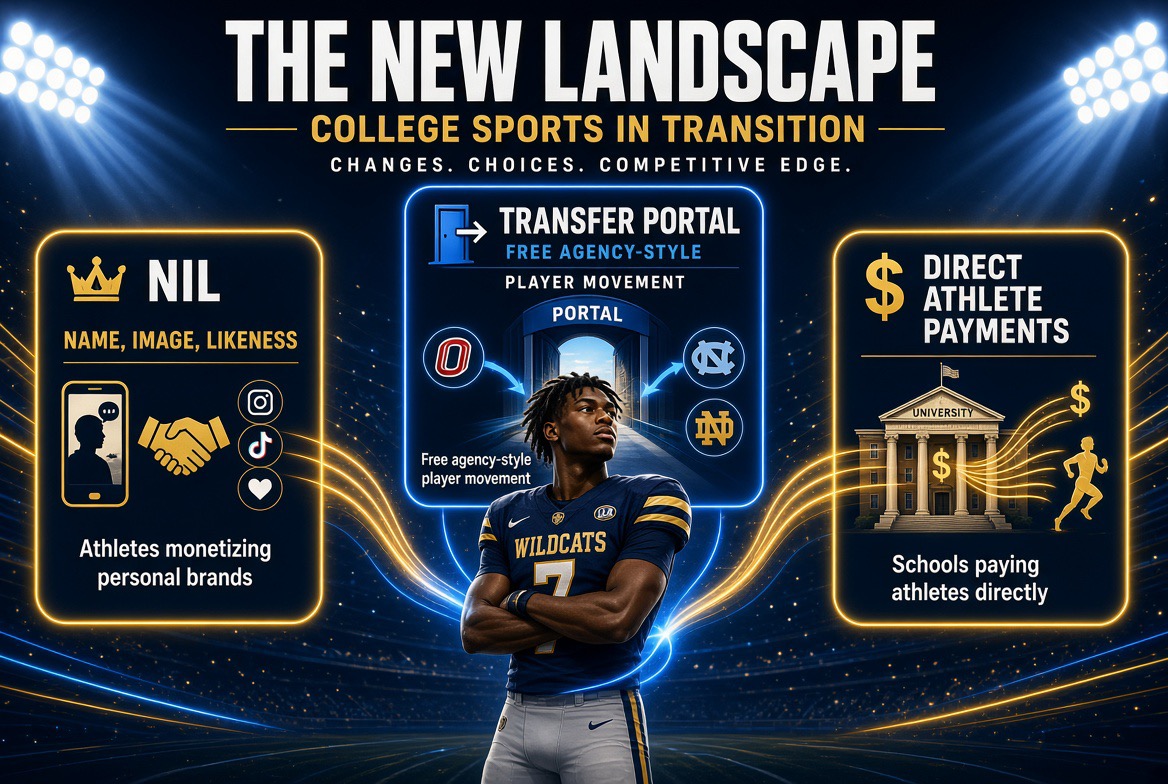 For more than a century, college sports operated under a deceptively simple dogma: student-athletes played for pride, tuition, room, and board, while television networks and universities generated billions in commercial profit. In late September 2026, the United States Senate decisively put the final nail in that amateurism coffin, passing the bipartisan Protect College Sports Act (S. 4668) with a 77–22 vote.
Combined with the landmark court settlement known across campuses as House v. NCAA, the collegiate landscape has completed a total metamorphosis. Colleges are no longer merely academic institutions that sponsor sporting clubs; they are now direct revenue-sharing employers and contract facilitators. While headline writers focus exclusively on whether a five-star quarterback or starting point guard is pulling in seven figures, the ground under non-revenue Olympic sports has experienced an equally violent earthquake.
What Actually Changed? The 3 Core Pillars in Plain English
• Direct Pay & Revenue Sharing (Universities Can Now Cut Checks)
Until recently, it was an NCAA felony for an athletic director to directly write a paycheck to a collegiate athlete. Today, major athletic programs (most notably the Power 4 conferences: SEC, Big Ten, Big 12, and ACC) are legally permitted to distribute up to roughly 22% of athletic department revenues directly to their athletes—amounting to approximately $21.6 million per university every year.
• NIL Gets Tamed By Federal Preemption
When Name, Image, and Likeness (NIL) first went live in 2021, it created a chaotic “Wild West” where third-party booster collectives raised donor money to effectively buy high school recruits. The new federal law sweeps aside contradictory state laws, installs a single federal registry, and mandates that third-party NIL contracts reflect legitimate, verifiable fair market value (commercial endorsements rather than concealed roster salaries).
• The Transfer Portal Gets Guardrails
The revolving-door era of players transferring every single semester has been curtailed. The legislation codifies a federal standard: one free, penalty-free transfer for undergraduates, with subsequent immediate-eligibility moves restricted to clear life events – such as a coaching staff firing, program cancellation, or completing an undergraduate degree. While these rules were negotiated with 85,000-seat football stadiums in mind, their collateral consequences are fundamentally rewiring the sports that share the backfield and running tracks.
Ground Zero: What This Means for Track & Field
Track and field is distinct from every team sport on campus. A single track team is essentially several different sports wrapped into one uniform: sprint relays, distance races, steeplechase, hurdles, pole vault, high jump, shot put, discus, hammer, javelin, and multi-events. Under the new regime, the financial and mathematical realities of running a track program have radically shifted.
“College track programs are caught in a vise: the old 12.6 scholarship ceiling is gone, but hard roster caps of 45 athletes mean the cherished walk-on culture has been decimated.”
Area of Change – The Post-2026 Reality
Roster Size & Walk-Ons – Hard roster caps: Max 45 athletes for Track & Field; 17 for Cross Country (SEC further capped men at 35/10). Walk-ons are largely eliminated.
Scholarships – Schools can award up to 45 full scholarships – if they have the budget. However, football absorbs ~75–85% of revenue-share pools.
Event Breadth – Hyper-specialization: Programs cut entire event disciplines (e.g., dropping hammer/javelin) to pack points into sprints or distance.
Title IX & Aid Distribution – Colleges face strict legal pressure to balance massive football direct payouts with significant female track & field aid.
Key Takeaways for Athletes, Coaches, and Parents
The End of the Late Bloomer: In past decades, high school runners who were raw or had late growth spurts could walk onto a Division I squad, train with world-class facilities, and emerge as national contenders. With hard 45-person caps, coaches can no longer gamble roster slots on developmental runners. Recruits must prove immediate scoring ability or look toward Division II, Division III, or NAIA.
Mid-Majors vs. Power 4 Divide: While Power 4 schools have the $21.6M revenue-sharing pools, mid-major institutions (who cannot afford direct payrolls) offer deeper rosters and broader event participation. Many top-tier national track performers are strategically choosing competitive mid-majors where their event group remains an institutional priority.
Congressional Safety Net: The September legislation did include a crucial win for track: a statutory Non-Revenue Roster Floor preventing schools with athletic budgets exceeding $50 million from eliminating Olympic sports to pay football salaries, preserving varsity status for legacy teams.
Conclusion: The Olympic Pipeline Under Pressure
The NCAA track and field circuit has long served as the primary feeder engine for Team USA’s Olympic track medals. As collegiate sports shift toward a semi-professional entertainment model dominated by gridiron football and television ratings, track coaches are forced to become financial portfolio managers. The sport will survive, but it will be leaner, more specialized, and undeniably more ruthless for the next generation of American runners, jumpers, and throwers.