The Path to a New 4×1 World Record
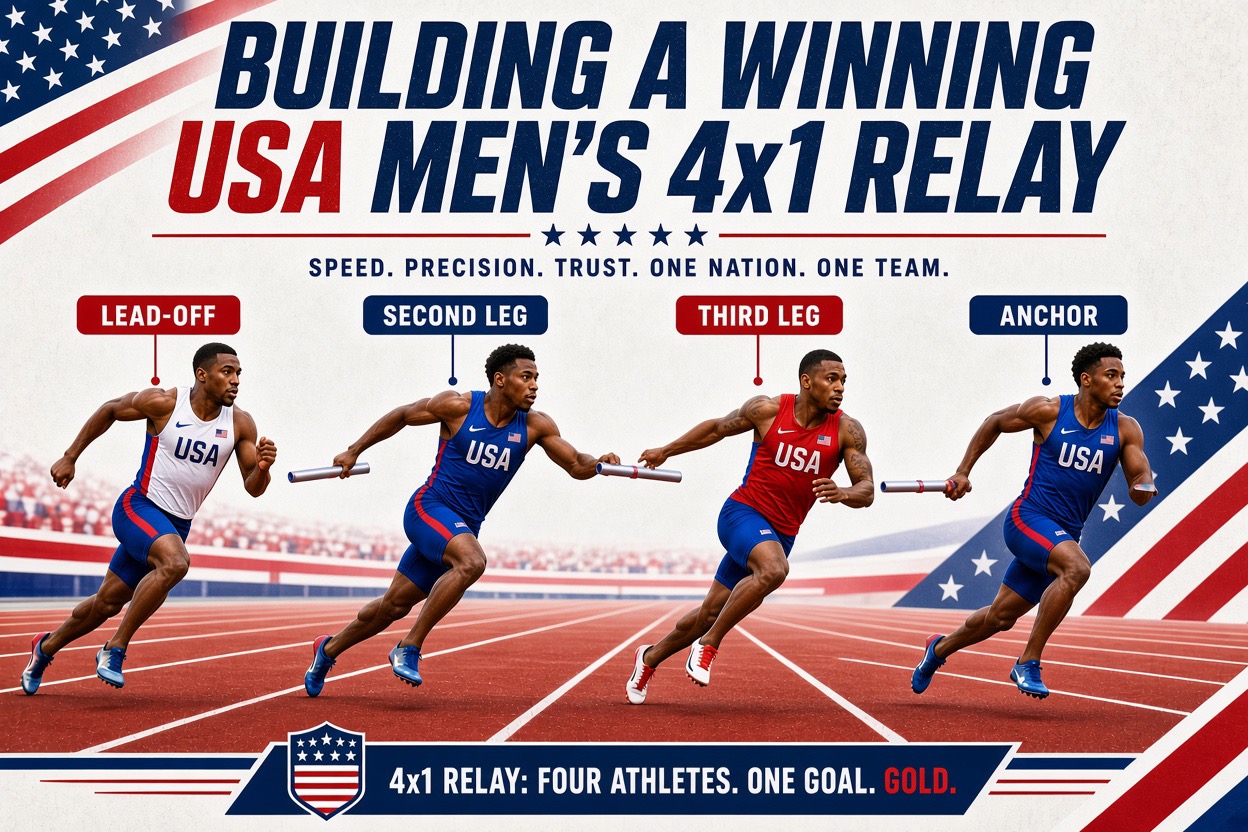 For most of the automatic timing era, the United States owned the men’s 4×100 world record. We set it in Mexico City in 1968, and apart from an 11-month stretch in 1990–91 when France held it, we had a stranglehold on it until 2008. That’s when Jamaica took it at the Beijing Games, then lowered it again in Daegu and London. The record has been away from home for 18 years. It’s time to bring it back.
It’s Execution, Not Speed
The issue has never been a lack of foot speed. The problem has been a lack of execution, much of it the result of “politics.” I don’t mean presidential or government politics of any kind. I mean shoe companies, agents, and others who aren’t coaches or athletes having a say in what happens on the track.
Relays are not nearly as difficult as our international squads make them appear. Our U20 squad just ran 38.16, and a group of Texas high school “all-stars” ran 38.56. The 4×100 is not rocket science, and it doesn’t take weeks of work to get it done, despite the complaints from elite groups about needing lengthy relay camps. Yes, time together helps. But you just need to understand how to build the steps and have the patience to execute them.
Personnel Is the Key
The real key is getting the personnel right. Once upon a time, the US could put any four sprinters on the track and get the job done. Those days are long gone. Other nations are doing a better job of developing their sprinters, and some, like Canada and Britain, take pride in their 4×100 execution. They see the relay as their shot at global medals. That makes it imperative that we select squads built for success.
We used to simply take the first four finishers at Nationals or Trials and put them on the track. That works when you’re the bully on the block and clearly superior to everyone else. Today it doesn’t, for two reasons. First, we are no longer that bully. Second, not a single leg of the 4×100 is like the 100m. Yes, each leg is 100 meters long, but none is run the way the open 100m is, out of the blocks and straight down the track. Only one leg comes out of the blocks, and it is run on a bend. Each leg requires different skills, so let’s look at those skills and at who our best athletes are to man them.
Leg 1: Lead Off – Christian Coleman
The lead off requires a good starter, since it’s the one leg that comes out of the blocks. This runner should also be a good turn runner. In my opinion, a good to great 200m sprinter works well here. That’s why Christian Coleman has been one of the best in history and is my choice to lead off Team USA. He’s the best starter in our current group of sprinters, and he’s a solid 200m man, with a best of 19.87.
Leg 2: Tate Taylor
The second leg is all straight, and no, it’s not the “longest” leg, as announcers would have you believe. The track is not lopsided, with a long backstretch and a short finishing straight. Every leg is the same length: 4 x 100m. What this leg requires is great acceleration down the straight, plus great finishing speed and nerves, because this runner handles the baton twice. At the elite level, someone with recent college or high school experience works well. My choice is Tate Taylor. Yes, he’s “young,” which in this case is a good thing. He has lots of recent relay experience, very good top-end speed, and 200m strength. He will make an excellent second leg.
Leg 3: Kenny Bednarek
This is where many squads lose it, and where the US used to be strong. You need an athlete who is used to handling the baton twice, has great turn-running ability, and is strong enough to push your anchor through the zone. Some of history’s best 200m men have run here, with Calvin Smith and Yohan Blake among the best. We’ve run Courtney Lindsey recently with success, but I want to see Kenny Bednarek here. He consistently runs great turns and has the prerequisites to do the job.
Leg 4: Anchor – Noah Lyles
The last leg, more commonly known as the anchor, is all that’s left. There’s a myth that this is the most important leg, I think primarily because high-profile athletes have run it, as if it were a reward for winning the 100m. Let me say this clearly: every leg is important. If anyone fails, the team loses. That’s why the US has lost races we should have won.
What we need in an anchor is someone with great top-end speed who is very competitive. He should be able to hold a lead if given one, but also be able to bail the squad out if things have gone poorly earlier in the race. Carl Lewis, Maurice Greene, and Usain Bolt were well-known anchors. The man for this team is Noah Lyles. With Noah on anchor, we win in Doha, Budapest, and
Tokyo. With this group, he could be bringing home a new world record.