What Sprint Results Mean
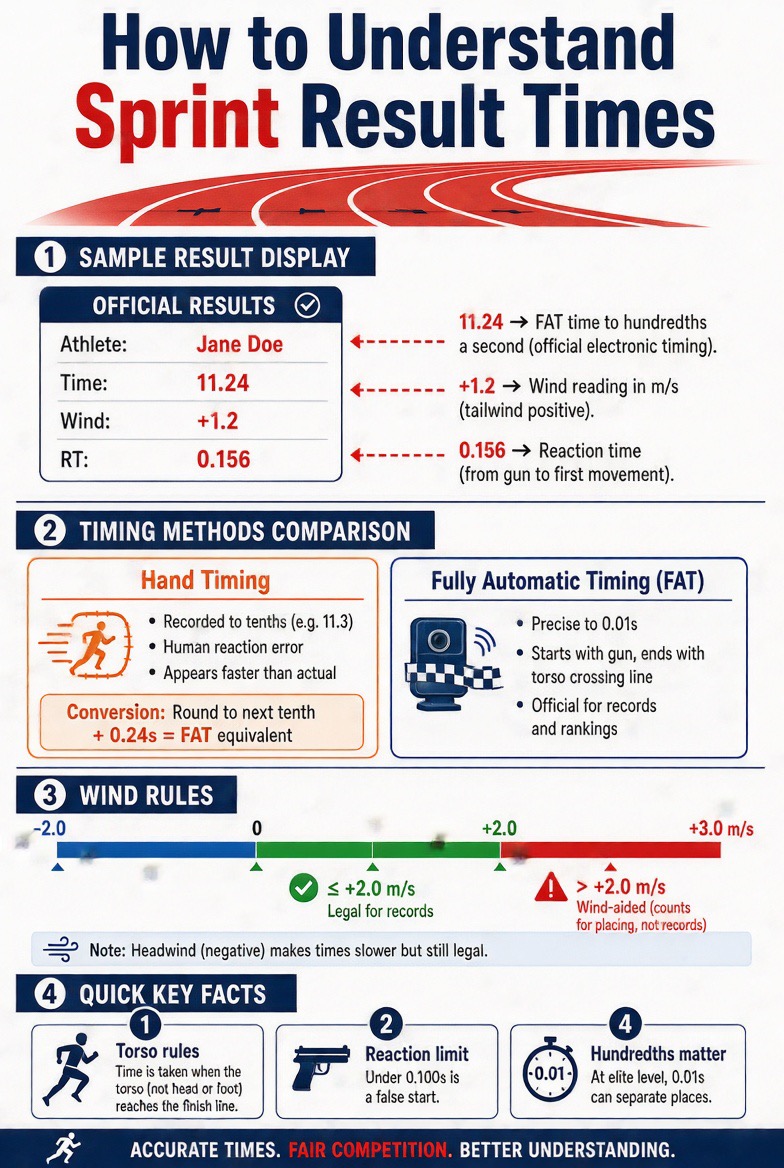 If you are new to track and field, a results sheet can look like a secret code. There is a time, then a small number beside it, maybe with a plus sign. The announcer says the run was “wind-aided,” and a minute later somebody online calls it “illegal.” Now you are lost. I want to clear that up. I think announcers and people online make this far more confusing than it needs to be. This guide covers the sprints and hurdles, because those are the races where wind matters: the 100 meters, the 200 meters, and the 100- and 110-meter hurdles. When you finish reading, you should be able to look at a result and know what it really says.
“Wind-aided” does not mean “illegal”
This is the biggest mix-up in the sport. When the tailwind in a race is stronger than 2.0 meters per second, the run is called wind-aided (or wind-assisted). Too many announcers say it as if the runner broke a rule. They did not. Nobody cheated and nobody was disqualified. The race still counts. The winner is still the winner, medals are still medals, and runners still move on to the next round. The only thing that changes is the record book: a wind-aided time cannot be used for a record, and it usually cannot be used for official lists or qualifying marks either.
Wind-aided means “not record-eligible.”
It does not mean illegal, cheating, or disqualified. Save the word “illegal” for things that really break the rules, like a false start. What makes a time “legal” for the record book? When I say a time is “legal,” I mean it passes two checks. Fail either one and the time is not record-eligible.
1. Timing – The time must come from fully automatic electronic timing: the starting gun sets the clock going and a finish-line camera stops it. Times from a person holding a stopwatch are not accepted for records. Hand timing only reads to a tenth of a second and depends on how fast a person reacts. Records in the short races have required automatic timing since the late 1970s.
2. Wind – The average tailwind during the race must be 2.0 meters per second or less. A small detail that trips people up: wind readings are rounded up to the next tenth. So a posted +2.0 could really have been anywhere from 1.91 to 2.00. A posted +2.1 is the first reading that counts as aided. That is how thin the line is, and it matters later in this guide.
Where did the 2.0 come from?
It came from a vote, not from an experiment. The limit was set in 1936 at a congress of the sport’s governing body (then called the IAAF, now World Athletics) in Berlin. One account says Germany proposed a limit of 1 meter per second, and the delegates settled on 2.0 as a compromise so they would not have to wipe out too many existing performances. Researchers who have looked at the history describe it as based on a small case study. Some have called it arbitrary. After all, why is 2.1 aided when 2.0 is fine?
It is a line in the sand, not a cliff.
The wind does not flip a switch at 2.0. A run at +2.1 gets almost the same help as a run at +2.0. Keep that in mind and the rest of this guide gets easy.
How the wind is measured
The wind reading is not a guess, but it is also not a perfect picture of what each runner felt. Here is how it works:
• One gauge, one spot. A wind gauge sits beside lane 1, 50 meters from the finish line, about 1.22 meters (4 feet) off the ground and no more than 2 meters from the track.
• A short window. In the 100 meters it measures for 10 seconds from the gun. In the hurdles it measures for 13 seconds from the gun. In the 200 meters it measures for 10 seconds, starting when the first runner enters the straight.
• One average. The gauge produces a single number, the average over that window, rounded up to the next tenth.
• Only some races. Wind is not measured in the 400 meters or longer, because runners go around the track and the wind helps them on one side and slows them on the other. Indoors there is no wind to measure. Even the number itself can be questioned. After a famous 1988 women’s 100 meters, later analysis suggested the real wind was much stronger than the 0.0 on the gauge. The record still stands. It shows that the reading is a useful tool, not a perfect one.
How much does wind really help?
Scientists have studied this for decades. For the 100 meters, the best-known study found that the maximum legal tailwind of +2.0 is worth about 0.10 seconds to a man and about 0.12 seconds to a woman, with a small margin of error. A computer model of the 110-meter hurdles came out higher, at about 0.19 seconds for +2.0. The 200 is trickier because part of the race is on the curve, where the wind hits runners from different angles, so I will stick to the 100 here.
Two more facts from that research matter. First, the help grows steadily as the wind gets stronger, but it grows a little more slowly the stronger the wind gets. Second, a headwind hurts more than a tailwind helps.
Extra help beyond the legal limit: men – women – help beyond +2.0
+1.0: about 0.05 s – about 0.06 s – none (legal)
+2.0: about 0.10 s – about 0.12 s – none (legal limit)
+2.5: about 0.12 s – about 0.15 s – about 0.02 to 0.03 s
+3.0: about 0.14 s – about 0.17 s – about 0.04 to 0.05 s
+4.0: about 0.18 s – about 0.21 s – about 0.08 to 0.09 s
(Estimates for a typical 100 m run. Real runners vary.)
How to read an aided time
Now you can put the pieces together. The question is not “is it legal or not?” The better question is “how much extra help did the wind give beyond the limit?” Here is the rule of thumb I use. It is my own judgment, not an official rule.
+2.0 or less Legal. The time can count for records and lists. Remember that +2.0 still carries a real boost.
+2.1 to +3.0 Aided, but only slightly past the limit. Treat it like a legal run with a little extra help. It is a real, believable performance.
+3.1 to +4.0 A clear boost. Still a fast run by a fast runner, but expect that athlete to need a good day and a good wind to get near it again.
Above +4.0 The wind did a lot of the work. Enjoy the race, but do not compare the time to legal times.
A worked example
Say a man runs 9.90 with a +2.5 tailwind. That wind is aided, so the time cannot go in the record book. But look at the numbers: +2.0 is already allowed and worth about 0.10 seconds. The extra half meter per second adds only about 0.02 to 0.03 seconds more. That is smaller than the natural ups and downs a sprinter has from one race to the next, even in the same conditions. A runner who can do 9.90 at +2.5 is clearly a 9.9-to-10.0 kind of sprinter, and I would expect him to run close to that in legal conditions. At +3.0, the extra help is still only about 0.04 to 0.05 seconds.
The best proof that a fast time is real is not a wind reading. It is the runner doing it again. Look at the athlete’s other races that season. If the aided time sits in line with them, believe it. If it is far faster than anything else they have run, the wind probably did a big part of the job.
Why “zero-wind calculators” do not work
You will find websites that take your time and your wind reading and promise to tell you what you would have run in zero wind. People then say things like, “That 9.90 at +2.5 is really a 9.78.” I think this is a mistake. The calculators are built on averages from research studies, and the researchers themselves say there is a margin of error. More important, what a person runs on a given day depends on much more than the number on the gauge:
• Your lane. The gauge sits beside lane 1. Lane 8 is a long way from it, and the wind is not the same everywhere on the track.
• The angle of the wind. The gauge measures the wind along the track. A wind that is partly sideways, or swirling, is not the same as one blowing straight down the lane.
• Gusts and timing. The reading is one average. A big gust at the start helps differently than the same gust at the finish, and the average hides which one happened.
• Who you run against. Runners push each other. A fast field can pull a runner to a time they would not run alone.
• You. How well you started, your form, how your body felt that day.
A calculator can give you a rough idea of how big the wind’s help might have been. That is fine for curiosity. But there is no such thing as a 9.90 that “equals” some zero-wind time. The runner never ran in zero wind that day. You run what you run.
Quick cheat sheet
You see or hear. What it really means
+1.3 next to a time – A tailwind of 1.3 meters per second. Legal wind. A plus sign means the wind helped, a minus sign means it hurt.
“Wind-aided” or “wind-assisted” – The tailwind was over 2.0. The race counts, but the time is not record-eligible.
“Wind-legal” – The tailwind was 2.0 or less.
An “A” next to a time – The race was at altitude (over 1,000 meters). Thin air helps sprinters a little. There is no limit on altitude for records, but the A tells you about it.
“Illegal” (used about wind) – Wrong word. Nothing illegal happened.
A hand-timed result (to the tenth) – Not accepted for records. Different tool, different level of accuracy.
A note on hundredths: the timing machines actually measure finer than a hundredth of a second, but official times are rounded up to the next hundredth. That is why you will never see a time with more than two decimal places in a normal results sheet.
What I would like announcers to say
Instead of “that run was illegal,” try: “That was a 9.90 with a 2.5 tailwind. It is wind-aided, so it will not count for the record book, but it tells us he is in great shape.” That one sentence is honest, it is clear, and it respects the athlete and the fans.
The Takeaway
Wind is a factor, not a verdict. Learn the limit, know what it is for, look at how far past it a run really is, and judge the runner by how they run over a whole season. Then watch the athletes run, and let it go.