Is Marcell Jacobs Injury-Prone? Yes. However That’s the Wrong Question
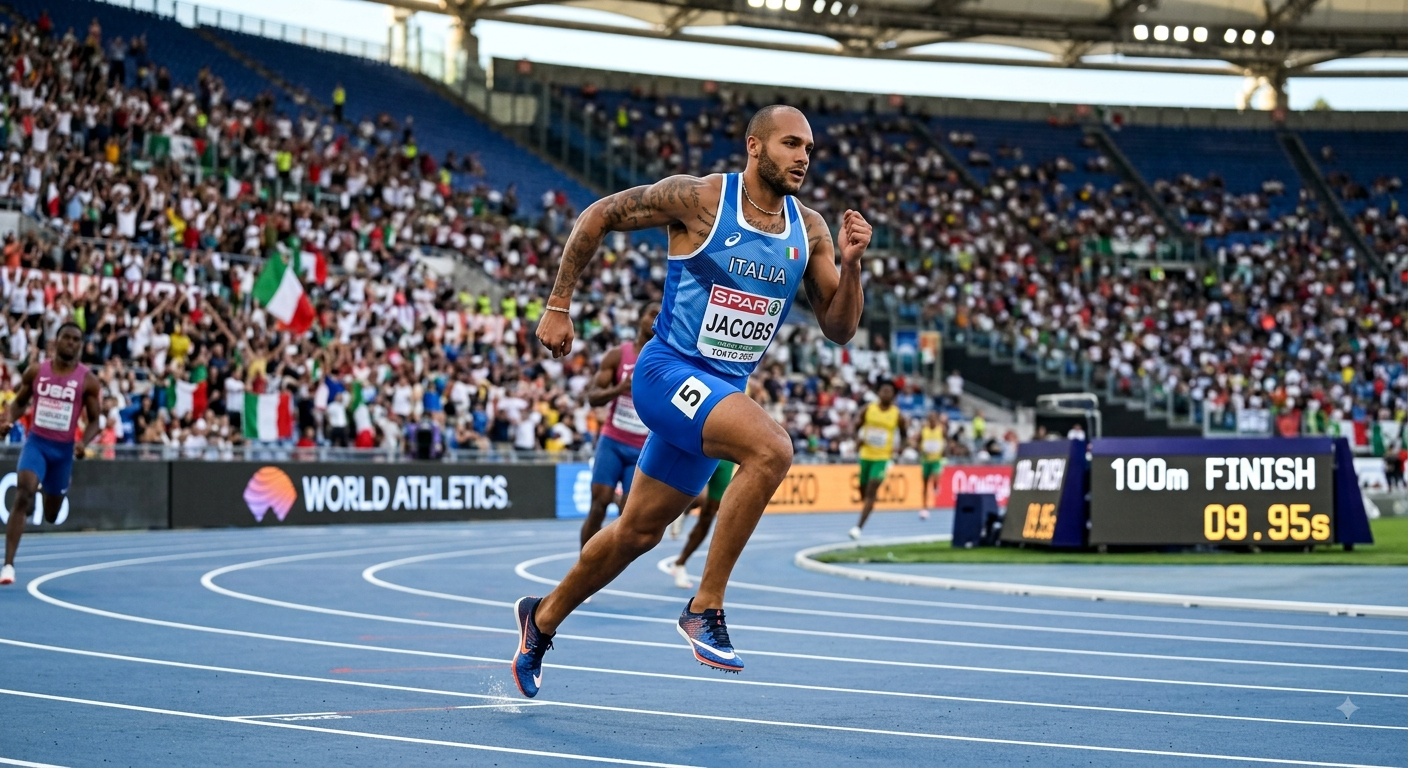 The Olympic champion’s recurring injuries aren’t evidence that he’s fragile. They illustrate the razor-thin margin between elite sprint performance and the body’s ability to tolerate it.
At the ’26 European Championships, the headliner in the men’s 100m was defending champion Marcell Jacobs of Italy, holder of the 9.80 European record set during his 2021 Tokyo Olympic triumph. After an effortless semifinal win, securing another title seemed like a formality. Then, roughly 40 meters into the race, Jacobs pulled up with an injury – reigniting debate over whether he is simply too fragile to sustain elite sprinting.
The Injury Prone Label
When Jacobs first appeared in the Tokyo Olympics, I was struck by how technically efficient he was. Since he wasn’t on anyone’s radar at the time, it was a total shock when he made, then won the 100m final. When he came back during the indoor season and won the World indoor 60m title in 6.41, Jacobs looked like a sprinter to be reckoned with for the foreseeable future. Then he followed that with the European 100m title, and everyone was looking forward to Jacobs facing the field at the ’22 World Championships. That race didn’t happen however, because Jacobs pulled out after the first round due to injury. The first of many soft tissue injuries that repeatedly interrupted his seasons and limited his racing, until he reappeared in Paris in ’24, made the 100m final and finished fifth in 9.85 – an excellent time in what was the deepest 100m final in Olympic history. Jacobs was back, except not quite, as he was unable to compete in Tokyo in ’25 as he was once again injured. Bringing us forward to the ’26 European Championships injury.
Watching a healthy Marcell Jacobs compete is a textbook case in sprinting technique. He displays excellent frontside mechanics, controlled pelvic positioning, minimal backside recovery and the ability to apply enormous force into the track with remarkably little wasted motion. Fans look at him and don’t understand why he’s pulling out of Diamond League meets and getting injured in championships.
Speed Comes With a Price
Here’s the thing about sprinting, even though you’re technically efficient, that doesn’t change how much force you’re placing on muscles and tendons. As a matter of fact, technical efficiency does not make an athlete immune to injury, because the very qualities that allow an elite sprinter to produce extraordinary speed also require the musculoskeletal system to tolerate immense forces. Sprint performance requires tissues to repeatedly tolerate enormous forces at extremely high velocities. Injury occurs when the mechanical demand imposed exceeds the tissue’s current capacity to tolerate that demand. The faster you are, the more force that is being applied, and if these parts of the body are not strong enough (force greater than tissue tolerance), they break. That helps explain why extraordinarily gifted and technically accomplished sprinters such as Jacobs, Trayvon Bromell and Elaine Thompson-Herah can nevertheless experience recurring soft-tissue problems.
Why Previous Injuries Matter
Here’s the part that leads to the impression that they may be injury prone. A previously injured muscle doesn’t simply reset to its pre-injury state. Healing involves remodeling of the damaged tissue, and previous hamstring injury is itself one of the strongest predictors of future hamstring injury. That makes rehabilitation and restoration of eccentric strength, fascicle capacity and sprint-specific load tolerance especially important. So that a previously injured athlete has to monitor how they rehab, because they must strengthen that area so that it can tolerate the force necessary to run fast. Then you must be careful how much you compete, because training can approximate competition-level loading, but competition removes much of the coach’s ability to control that load – and championship rounds can require repeated maximal efforts within 24–48 hours.
So an elite athlete like Jacobs or Bromell, must be more targeted when setting up a competitive schedule, and must be cognizant of noticeable “tweaks” during warmups, which is why you see certain athletes pull out of competitions days, or even minutes from competition. In an attempt to be ready to compete in the meets that matter most.
Can Jacobs Stay Healthy Through Los Angeles?
Will we see Jacobs in Beijing in ’27, or in Los Angeles in ’28? History and sports science say that it’s possible. He’ll be 33 in ’28 and athletes have done well at that age – Justin Gatlin, Carl Lewis, and Linford Christie among them. The key will be training and race management between now and then.
To stay healthy for Beijing 2027 and Los Angeles 2028, Jacobs requires a highly calculated approach. What Jacobs’ Management Probably Requires:
Carefully controlled exposure to maximum velocity, progressive eccentric/isometric strength work, individualized monitoring of previous injury sites, sufficient recovery between maximal efforts, selective competition scheduling, and championship-specific preparation for rounds.
So, yes Marcell Jacobs is injury prone, but not because he’s fragile. Like a Formula 1 race car, he’s a finely tuned racing machine, that because of previous injury is attempting to balance between being at his best and breaking down. When fans see an athlete such as Jacobs withdraw from a meet, it shouldn’t automatically be interpreted as fear or unwillingness to compete. For an athlete with his injury history, withdrawing at the first sign of a problem can simply be rational risk management. As he proved in Tokyo in ’21 and Paris in ’24, when he’s healthy he is one of the world’s fastest humans and a contender in Beijing and Los Angeles. He just has to get there in one piece.